
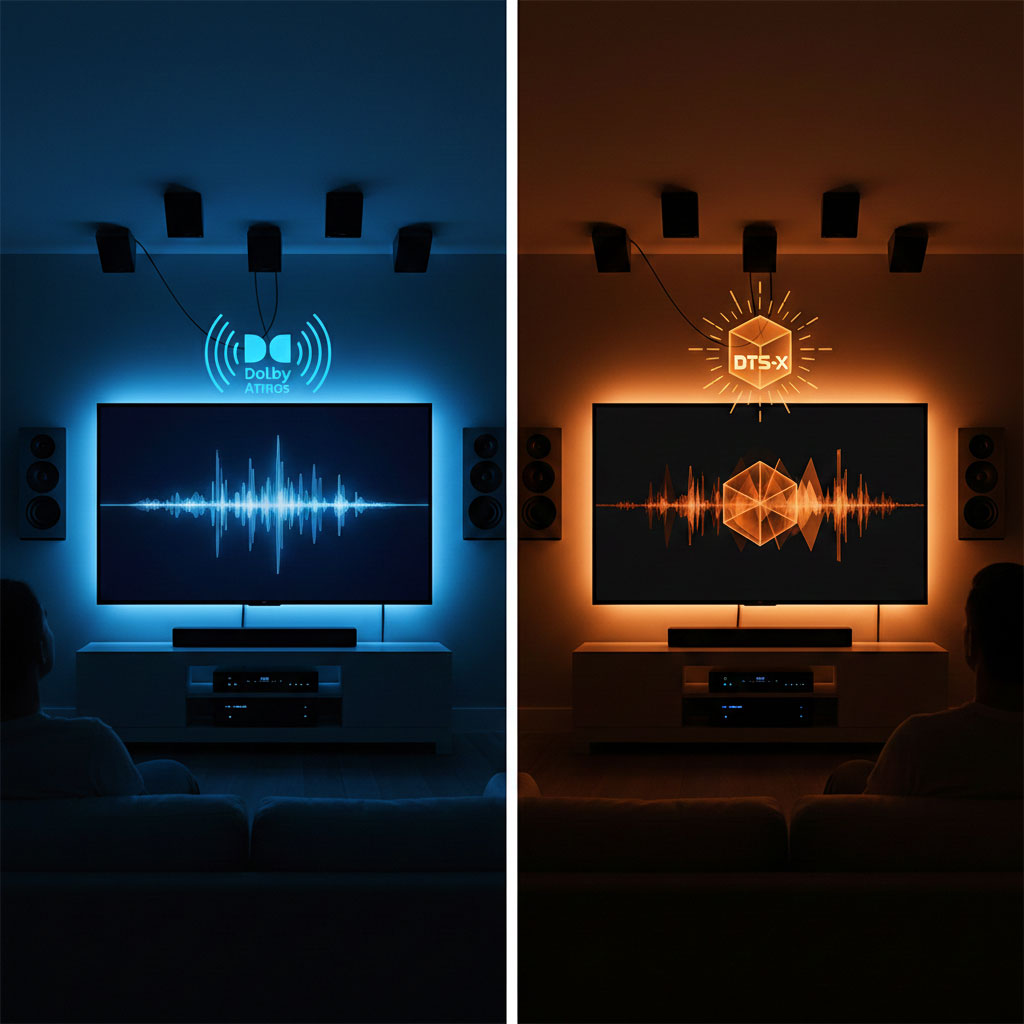
Choosing between Dolby Atmos and DTS:X can feel overwhelming when planning your home cinema. Both technologies promise immersive, three-dimensional sound that places you inside the action, but they achieve this through different approaches that affect speaker placement, content availability, and overall performance in your viewing space.
How Each System Creates Immersive Sound
Dolby Atmos and DTS:X both deliver object-based audio, moving beyond traditional channel-based systems to treat audio elements as individual objects positioned anywhere in three-dimensional space. The key difference lies in their flexibility and precision approaches to creating that soundstage.
- Dolby Atmos works with predetermined speaker configurations and requires content mixed specifically for its format
- The system uses metadata to position up to 128 audio objects simultaneously, creating a precise soundstage
- DTS:X offers more flexibility, adapting to whatever speaker configuration you have without requiring specific layouts
- It can work with fewer speakers whilst still delivering impressive spatial audio
- DTS:X proves more forgiving for varied room setups and unconventional speaker placements
Dolby Atmos typically delivers more precise object placement when properly installed with its recommended configurations. DTS:X’s adaptive nature makes it more practical for rooms where ideal speaker placement isn’t possible.
Speaker Requirements and Installation Flexibility
Your speaker setup significantly influences which system works best for your space. Physical constraints of your room often determine which format proves more practical to implement effectively.
- Dolby Atmos typically requires ceiling-mounted or upward-firing speakers for height channels
- Standard configurations include 5.1.2, 7.1.4, or more ambitious layouts with additional height speakers
- DTS:X can create height effects without dedicated ceiling speakers through clever processing
- Both systems work with soundbars, though dedicated speaker systems deliver superior results
- Minimum requirements start at five speakers plus subwoofer, though more speakers enhance immersion considerably
If installing ceiling speakers isn’t feasible in your property, DTS:X’s adaptability might prove more practical. However, Dolby Atmos with properly positioned height speakers often delivers a more dramatic overhead effect when installation is possible.
Content Availability and Streaming Options
The amount of available content differs substantially between formats, which impacts how often you’ll actually experience each technology. Dolby Atmos dominates the streaming landscape whilst DTS:X remains primarily a physical media format.
- Dolby Atmos appears on Netflix, Disney+, Apple TV+, Amazon Prime Video and most major streaming services
- 4K Blu-ray releases more commonly feature Dolby Atmos tracks than DTS:X alternatives
- DTS:X appears primarily on select 4K Blu-ray releases and remains rare on streaming platforms
- Many AV receivers decode both formats, providing flexibility regardless of content source
- Gaming consoles increasingly support Dolby Atmos for compatible titles and immersive gaming experiences
If you primarily stream content, Dolby Atmos offers far broader compatibility across services. DTS:X remains worthwhile for physical media enthusiasts with extensive Blu-ray collections.
Equipment Costs and Compatibility Considerations
Budget plays a crucial role in your decision-making process, though modern equipment often supports both formats. The good news is that you rarely need to choose exclusively between formats when purchasing quality gear.
- Mid-range AV receivers from £400 upwards typically support both Dolby Atmos and DTS:X decoding
- Speaker packages suitable for object-based audio start around £800 for entry-level systems
- Premium installations with in-ceiling speakers can exceed £3,000 for speakers alone
- Dolby Atmos soundbars range from £300 to £1,500 depending on quality and features
- Most modern equipment supports both formats, eliminating forced choices between technologies
Investing in a quality AV receiver that decodes both formats provides future-proofing for your installation. Focus your budget on quality speakers and proper acoustic treatment rather than obsessing over format superiority.
Making the Right Choice for Your Cinema Room
Neither format is objectively superior as both deliver exceptional immersive audio experiences when properly implemented. Your choice should depend on your specific circumstances, room constraints, and content preferences rather than abstract technical specifications.
- Consider Dolby Atmos if you stream regularly and want maximum content compatibility
- Choose it if you can install ceiling speakers for optimal height channel performance
- Select DTS:X if you’re primarily a physical media enthusiast with extensive Blu-ray collections
- Opt for it if installation constraints prevent ceiling speakers in your room
- Remember that proper speaker positioning and room treatment matter more than format selection
Most importantly, invest in quality speakers, proper positioning, and room acoustic treatment as these factors influence your listening experience far more than format selection. A well-calibrated system with either format outperforms a poorly set up system every time.