
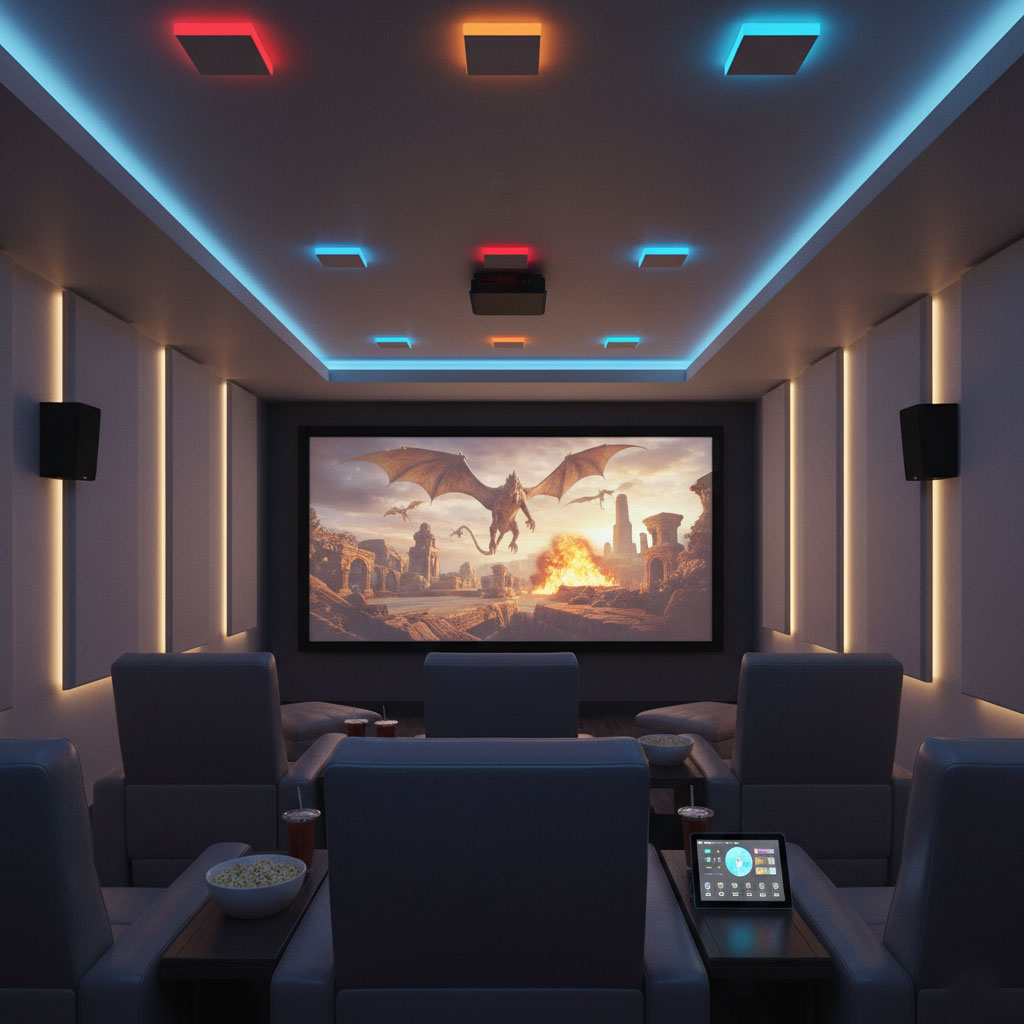
For many UK homeowners, the dream of a high-octane home cinema often clashes with the reality of semi-detached living, sleeping children, or late-night viewing habits. The traditional “cinematic” experience is built on high sound pressure levels and a wide dynamic range, where the gap between a whisper and an explosion is vast.
However, when the volume is turned down, this range often causes dialogue to become unintelligible while action sequences remain jarringly loud. Achieving “reference-level” quality at a lower decibel count is not about sacrificing power, but about intelligent signal processing and physical feedback.
By optimising how sound is delivered and felt, you can maintain the emotional impact and clarity of a film without disturbing the rest of the household or the neighbours.
Utilise Dynamic Range Compression (Night Mode)
Most modern AV receivers and high-end soundbars feature a setting often labelled as “Night Mode,” “Midnight Mode,” or more technically, Dynamic Range Compression (DRC). This is the single most effective electronic tool for low-volume viewing.
- Levelling the Field: DRC reduces the volume of the loudest sounds (explosions, gunshots) and boosts the quietest ones (whispers, footsteps), bringing them closer together in the mix.
- Preserving Detail: By narrowing the dynamic range, you can set a master volume that is low enough for late-night use while ensuring that subtle Foley effects are still audible.
- Smart Algorithms: Many 2026-era receivers use AI-driven “Loudness Management” that adjusts the EQ in real-time to compensate for the human ear’s reduced sensitivity to bass at low volumes.
- Customisable Tiers: Most systems allow you to choose the level of compression, from “Standard” to “Maximum,” depending on how much you need to dampen the peaks.
Dynamic range compression ensures that you are no longer “riding the remote,” constantly turning the volume up for dialogue and down for action.
Enhance the Centre Channel Performance
The centre channel is the workhorse of your cinema system, responsible for up to 70% of the soundtrack, including almost all dialogue. When volume is restricted, this channel is usually the first to lose its impact.
- Independent Level Calibration: Go into your receiver’s settings and manually increase the centre channel by +2dB or +3dB relative to the other speakers. This makes dialogue “pop” even at low overall volumes.
- Frequency Crossovers: Setting your centre channel to “Small” and using an 80Hz or 90Hz crossover ensures it isn’t wasting energy on low frequencies, resulting in crisper vocal reproduction.
- Dialogue Lift Features: Some processors offer a “Dialogue Enhance” feature that specifically targets the frequency range of the human voice to pull it out of a complex soundstage.
- Physical Aiming: Ensure the centre speaker is angled directly at your ear height; even a few degrees off-axis can cause a significant drop in high-frequency clarity at low volumes.
Focusing your system’s energy on the centre channel ensures that the narrative remains clear and engaging, even when the “theatre” is quiet.
Integrate Tactile Transducers (Bass Shakers)
One of the biggest losses at low volumes is the physical “thump” of the bass, as subwoofers need high volume to move enough air for you to feel the vibration. Tactile transducers solve this by bypassing the air entirely.
- Direct Physical Feedback: These devices are bolted to the frame of your cinema seating and convert low-frequency audio signals into physical vibrations.
- Silent Impact: You can “feel” the roar of a jet engine or a heavy footstep through your seat, even if your subwoofer is turned almost completely off.
- Brain Deception: By feeling the vibration, your brain perceives the sound as being much “bigger” and louder than it actually is, maintaining the cinematic “wow factor.”
- Low Power Requirement: Transducers are highly efficient and can be driven by a small, dedicated amplifier tucked away in a cabinet.
Tactile transducers are the “secret weapon” of late-night cinema, providing the visceral thrill of an IMAX theatre without any of the acoustic spill into adjacent rooms.
Prioritise Near-Field Listening Positions
In a standard UK living room, sound has to travel several metres to reach the listener, losing energy and bouncing off hard surfaces along the way. Near-field listening brings the sound sources closer to you.
- Reducing Room Interference: By sitting closer to your speakers (or moving speakers closer to you), you hear more “direct” sound and fewer “reflections” off the walls and ceiling.
- Increased Detail: At a shorter distance, the speakers do not need to work as hard to deliver fine details, allowing you to hear subtle textures at much lower decibel levels.
- Immersive Enclosure: Bringing the surround speakers closer to the seating area creates a tighter, more intimate sound bubble that feels louder to the user but remains quiet for those outside the zone.
- Acoustic Treatment: Using soft furnishings or “acoustic clouds” directly above the seating area further contains the sound, preventing it from travelling through the house.
Near-field setups allow you to achieve a high-fidelity experience by focusing the sound energy exactly where it is needed—at your ears.
Upgrade to High-Sensitivity Speakers
Not all speakers are created equal when it comes to low-volume performance. Some require significant power to “wake up,” while high-sensitivity models are designed to be articulate even at a whisper.
- Sensitivity Ratings: Look for speakers with a rating of 90dB or higher. These require less power to produce a clear signal and tend to remain more linear at lower volumes.
- Horn-Loaded Tweeters: Often found in high-performance cinema brands, horn-loaded designs are exceptionally efficient and maintain high-frequency detail without needing to be pushed hard.
- Reduced Distortion: High-quality drivers with lighter cones can react more quickly to small electrical signals, preserving the “transient” sounds like a twig snapping or a click of a gun.
- Consistent Tonality: Better-engineered speakers maintain their tonal balance across the volume range, so you don’t lose the “sparkle” in the treble when you turn things down.
Investing in high-quality, sensitive speakers ensures that the “soul” of the movie’s soundtrack remains intact, regardless of the position of the volume knob.
Reclaim Your Late-Night Movie Experience
Achieving cinema-quality sound at low volumes is a masterclass in balance and strategic upgrades. In 2026, the combination of advanced digital processing like “Night Mode” and the physical immersion of tactile transducers has made it possible to enjoy a “big” sound experience in the quietest of environments. By optimising your centre channel for dialogue and bringing your listening position closer to the action, you no longer have to choose between a mediocre movie night and a frustrated neighbour. A truly great home cinema adapts to your lifestyle, delivering a reference-grade performance that respects the boundaries of your home while never compromising on the emotional weight of the storey.